Handout · Day 3

Listening for Processes · Attitudes & Opinions

Duration: 90 minutes Module: Listening Focus: Mechanical parts, actions, process descriptions, attitudes, opinions, decisions

Objectives

0:00 – 0:10

Warm-Up: Mechanical Vocabulary

Brainstorm in pairs: what's the difference between a pump and a pipe? Between a spring and a wheel? You'll hear vocabulary like this in Section 2 monologues, especially when a machine, device, or process is being explained.

Common machine parts

0:10 – 0:30

Understanding Mechanical Parts

Audio — extract matching

Match extracts to images

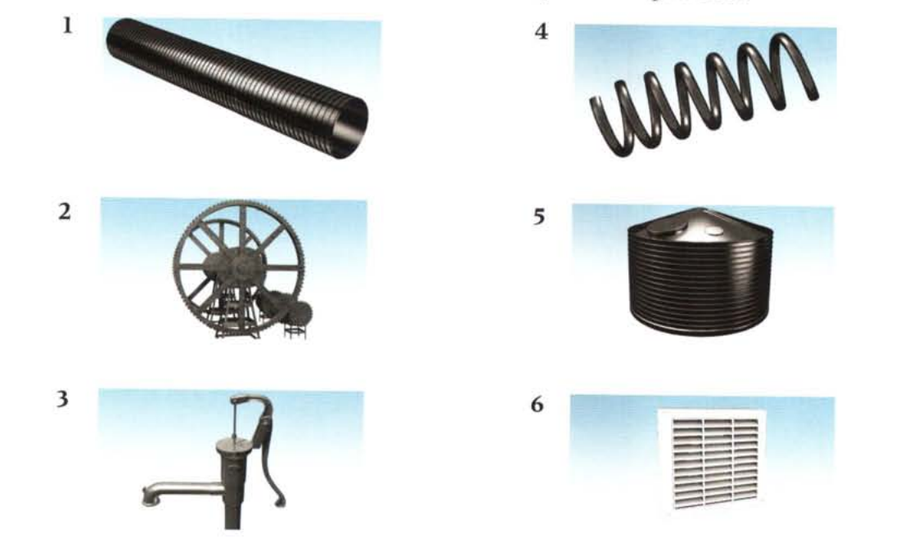
Look at the six images below. Listen to extracts A–F from different talks and match each one to the image it describes.

Six numbered machine-part images: 1 a length of pipe, 2 a large wheel mechanism, 3 a hand water pump, 4 a metal spring, 5 a water tank, 6 a ventilation grille.
  1. "At the bottom of the system there is a storage tank…" matches image:
  2. "A small spring in the centre causes the toy…" matches image:
  3. "The water passes through the pipe and…" matches image:
  4. "The water in the pool was becoming quite polluted so a pump…" matches image:
  5. "There is a very fine grille at different points…" matches image:
  6. "There is a wheel on the side, which is attached to…" matches image:

A 5 (storage tank) · B 4 (spring) · C 1 (pipe) · D 3 (pump) · E 6 (grille) · F 2 (wheel)

Audio — Party Popper Machine

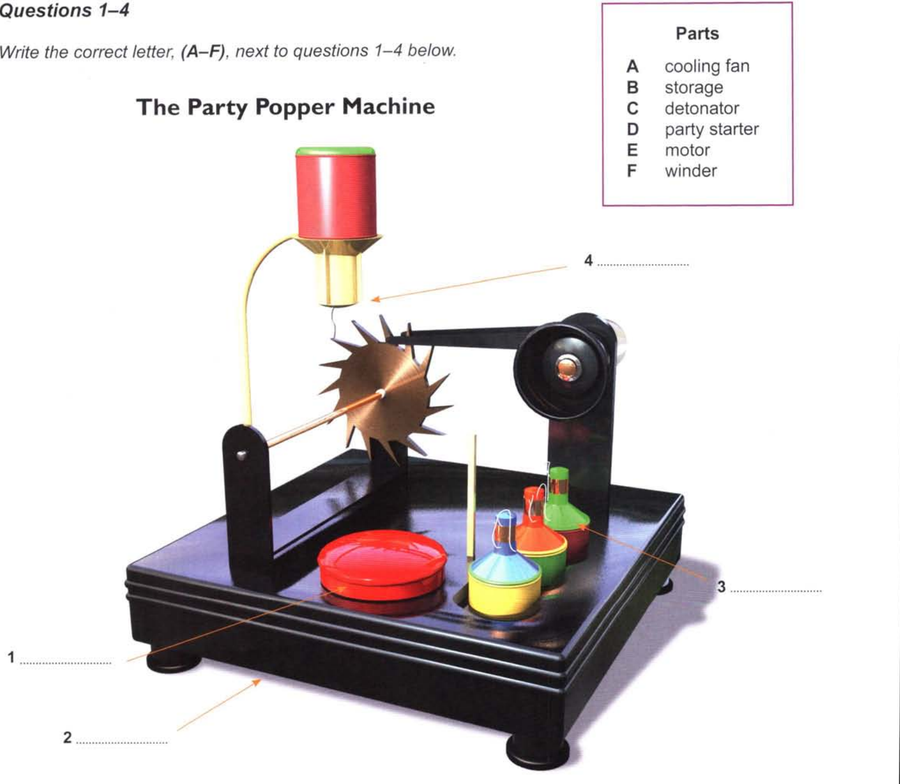
Label the Party Popper Machine

Look at the diagram and the list of parts. Listen and write the correct letter (A–F) next to each numbered position. Options: A cooling fan · B storage · C detonator · D party starter · E motor · F winder.

Diagram of the Party Popper Machine showing a base, a spiked wheel, a motor pulley, a red canister and small bottles, with numbered pointers 1 to 4 and a parts list A to F (cooling fan, storage, detonator, party starter, motor, winder).
  1. Position 1 (bottom left foot of the device):
  2. Position 2 (base, near the foot):
  3. Position 3 (small bottles on the top of the base):
  4. Position 4 (top, the cylindrical container that sits above the spike):
Test tip

With diagram labelling, look at all six options before listening. Two will be distractors that could fit the image but won't be mentioned, or will be mentioned in passing without being labelled. Follow the speaker through the diagram in order — they almost always describe it in the direction something moves.

0:30 – 0:50

Describing a Process

Process descriptions use sequencers (First, Then, Next, Finally) plus a stream of action verbs. The key is to predict the verbs from the situation before you listen.

Action verbs to know

Audio — wrapping a present

How to wrap a present

Listen to the process description and fill in the gaps with the verb you hear.

Here's how to wrap a present. First, gather together all of the things you need: wrapping paper, sticky tape, scissors, some ribbon and, of course, a present. Then, 1. your present on the opened wrapping paper and 2. a suitable amount using the scissors. Next, 3. the paper around the present and 4. it down with sticky tape. Then, neatly 5. up each of the ends of the paper and 6. them down. Finally, 7. the ribbon around your present. It's now ready to present!

1. place   2. cut   3. wrap   4. stick   5. fold   6. stick (or: tape)   7. tie

Note the sequencers: First, Then, Next, Then, Finally. These are your roadmap through the process.

0:50 – 1:10

Attitudes & Opinions

In Sections 3 and 4 the speakers don't just state facts — they have opinions. The question might be "How does the speaker feel about X?" and your job is to listen for tone and adjective choice.

Attitude vocabulary — match these

Synonym matching

Match each word on the left to its synonym on the right.

AttitudeSynonym (a–g)
1. worried   a. dubious
2. enthusiastic   b. hesitant
3. afraid   c. annoyed
4. confused   d. concerned
5. irritated   e. scared
6. reluctant   f. puzzled
7. doubtful   g. eager

1 d (worried → concerned) · 2 g (enthusiastic → eager) · 3 e (afraid → scared) · 4 f (confused → puzzled) · 5 c (irritated → annoyed) · 6 b (reluctant → hesitant) · 7 a (doubtful → dubious)

Audio — agreement levels

Agreement, disagreement, or in between?

Listen to eight extracts. For each, decide whether the speaker shows: A strong agreement · B neither complete agreement nor complete disagreement · C complete disagreement.

Listen for these cue phrases
  • Strong agreement: "absolutely", "exactly right", "no doubt about it"
  • In between (qualified): "a bit unsure", "not entirely convinced", "I see your point but…"
  • Disagreement: "I don't think so", "that doesn't make sense", "I have to disagree"
1:10 – 1:25

Reaching a Decision

In Section 3, two or three speakers often have to choose between options. Your job is to track who's leaning which way and which option wins in the end.

Audio — decision dialogue

Decisions

For each pair, predict possible advantages/disadvantages before listening, then choose.

Section 1 question: The speakers decide to travel to the airport by: A taxi · B bus · C car.

Section 3 question: What do the students decide to do next? A ask their tutor for help · B do more research on the topic · C produce a typed copy of their notes.

Note any phrases used to reach the final decision:

Decision-language to listen for
  • "Let's go with…" / "OK, that's settled"
  • "Right, so we'll…" / "I think you're right"
  • "Actually, on second thought, let's…" (the U-turn — watch for this)
1:25 – 1:30

Wrap-Up & Homework

Tonight's homework

Write a short process description of your own (how to make tea, brush a dog, change a tyre — anything with 5+ steps), and practise opinion phrases. About 30 minutes.

Open homework →

Practice online (free)

A little extra self-study for this skill — each link opens in a new tab. These are free resources; some may ask you to create a free account.